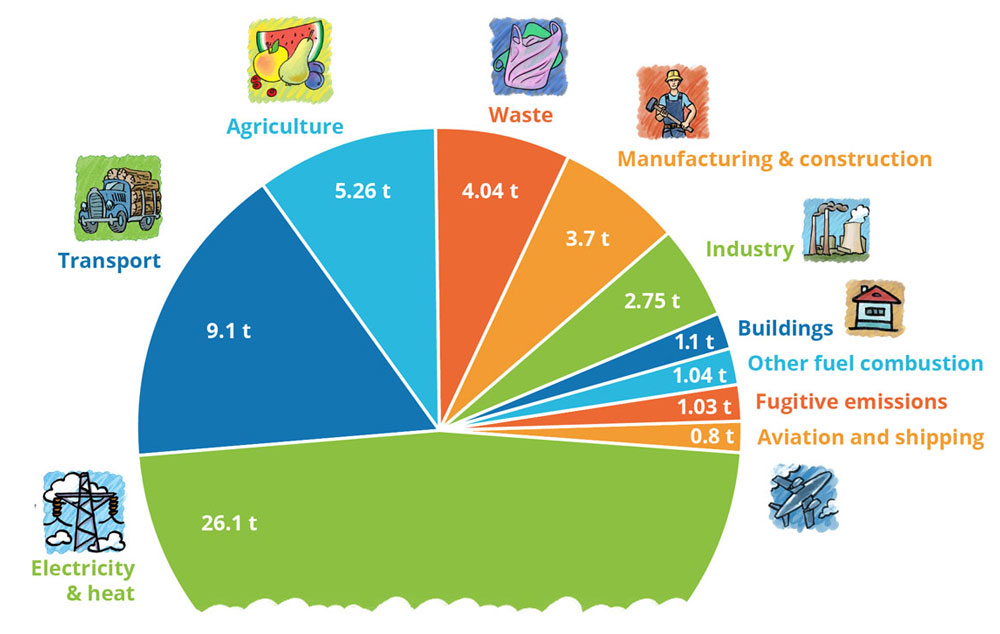
Greenhouse emissions by sector, Bulgaria, 2016

“We cannot solve our problems with the same thinking we used when we created them.”
Climate is a long-term weather regime in a certain geographical area, characterized as a result of many years of statistical research on such parameters as temperature, sunshine, humidity, atmospheric pressure and others. The world community has been monitoring the climate changes that have been observed in recent decades with increasing concern, defining them as one of the greatest threats of the 21st century. The effectiveness of plans and measures taken to tackle climate change depends to a large extent on public awareness and willingness to support them.
Learn more:
Write on separate sheets/cards 5-10 different phrases containing information related to weather or climate, for example:
Explain to students the difference between Weather and Climate. Initiate the following game. Have all students stand in the middle of the classroom. Designate one corner of the room as the Climate home and the other one as the Weather home. Begin taking out the cards one by one, reading the recorded phrases. Have the students go to one of the two corners depending on whether they identify the given information as Weather or Climate related. Those students who have difficulty finding their way can stay in the middle of the classroom. Continue playing until all participants correctly understand the difference between weather and climate.
Research the climate in your locality (region) by consequently answering the questions:
Conduct a survey among your parents, neighbors and various representatives of the community (workers, farmers, traders, representatives of the public administration) whether they believe that climate change may affect their professional activities. Share your findings and describe them in a short report supported by photographs you have taken.
Carry out the experiment "Greenhouse Effect – a Model of the Earth" and discuss the observed results.

Play the video "What is the Greenhouse Effect?"
Discuss the following questions:
Present the video "Climate Animation" to the class. Discuss the following questions:
Nominate four volunteers who will be given the task to research and report to the class which are the main greenhouse gases using the information provided in the INFO-portal, in the fact sheet "Greenhouse gases" as well as other Internet sources.
Have the four speakers share with the rest of the class what they have learned about the main greenhouse gases. Discuss which activities in your area may be a source of greenhouse gases.

Organize a role-play performing a Regional Conference on Climate Change. For that purpose, identify 9 volunteers to familiarize themselves in advance with several main factors considered responsible for the ongoing climate changes, namely: mining, energy production, transport, industry, agriculture, trade, food production,, deforestation, households.
Have volunteers present to the class how each of the factors listed contributes to adverse climate change. Try to scale the factors depending on the specific situation in your locality/region.

Identify several typical Bulgarian regions/settlements where a person can live, for example:
Divide the class into several groups, the number of which corresponds to the number of residential areas. The task of each group is to investigate the living conditions in each specific region. Have students discuss and record the positives and negatives of:
Let each group briefly present the results of the discussion to the representatives of the other groups. Could it be claimed that some places have a better quality of life because of their climate? Are there regions at increased risk to human health and the environment as a result of climate change? Could such risk be particularly important in choosing where we prefer living?
Assign students to conduct an interview with an elderly person, such as a grandparent or a neighbor with many years of life experience, based on the following questions.
Share your findings with your classmates.
Share your findings with your classmates. Discuss the results of the interview with your family, as well as the lessons learned within the activities described above.
Organize individual or group creation of message cards on the topic of climate change, in which young artists recreate their attitude towards nature and climate, give a creative advice, recommendation or idea on how to protect nature and mitigate the negative effects of climate change . Any materials can be used for the artistic design. Organize a mini-exhibition or send message cards to different institutions.
Action is awareness, but awareness is not action You can have awareness without action, but you can not have action without awareness. The important message is that being aware of the climate challenges does not necessarily mean that you are acting to overcome them — which is a common misconception we have in our world today. Аwareness without action is worthless!


