Greenhouse gases
Atmospheric gases (water vapor, carbon dioxide, methane, nitrous oxide, ozone, some freons, etc.) that absorb and emit radiation back to the earth's surface are called greenhouse gases. This process underlies the greenhouse effect.
Greenhouse gases have a strong effect on the Earth's temperature and without them the Earth's surface would be 30-40 ° C colder than it is now.
After the industrial revolution that began in the mid-18th century, human activity significantly increased the level of greenhouse gases in the Earth's atmosphere. Nowadays, scientists consider this increase to be the most probable reason for the increase in the global average temperature of the Earth after the middle of the 20th century.
About 99.9% of the water vapor in the atmosphere is of natural origin. Although it is a powerful greenhouse gas, water vapor is not seen as the culprit for global warming.
About 77% of carbon dioxide, 14% of methane and 8% of nitrous oxide in the atmosphere are the result of human activity.
The global warming potential (GWP) of carbon dioxide is 1 and it serves as a basis for comparison with the GWP of other greenhouse gases. The GWP for methane is 23, and 296 – for nitrous oxide.
- Learn more about greenhouse gases
- Share of global greenhouse gas emissions by sector
- Greenhouse gas emissions per capita in selected countries
- Greenhouse gas emissions per capita in EU
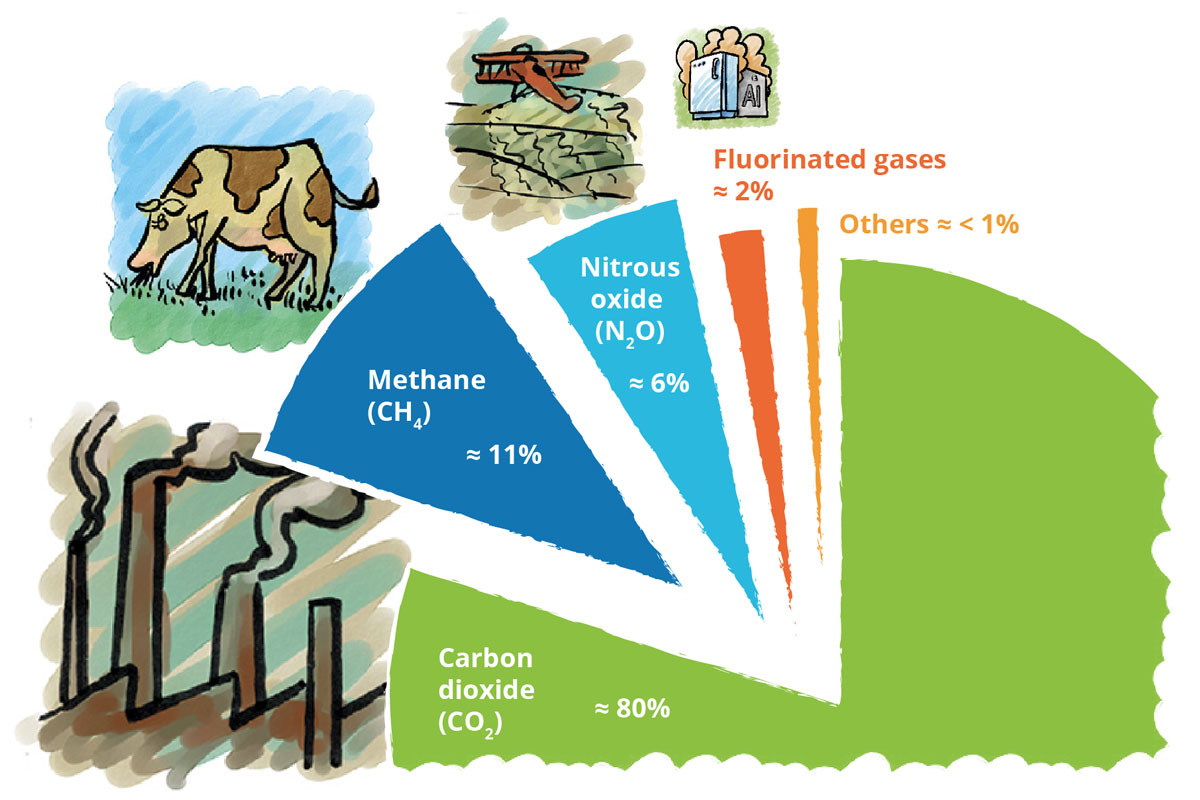
Share of greenhouse gas emissions in EU by pollutants
Source: European Environment Agency, 2019